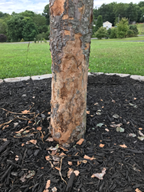
The client sent photos of a pink dogwood tree with bark peeling from ground up. The photo showed extensive bark loss well up the tree. The client wanted to know what caused the problem and how to take care of the tree. Dogwood borer (Synanthedon scitula) was identified as the cause. However, because of the clearly extensive amount of damage, there is no effective treatment at this point in time. It would be best to remove the tree, as it cannot be saved with that amount of bark loss.
ADDITIONAL INFORMATION
Larvae of the dogwood borer feed in the inner bark of live, healthy dogwood trees. The damaged area of the trunk or branch swells and eventually the bark will fall off. Leaves turning red prematurely in mid-summer on a lone branch are an early sign of dogwood borers. Infested branches and limbs will die. Dogwood borers often will not kill the tree in the first year, but reinfestation in successive years will. Plants attacked include: Dogwood, pecan, elm, hickory, and willow (1, 2, 3) Dogwood borer moths are in the same family of clearwing moths (sesiidae) as the peachtree borer, rhododendron borer and the lilac borer (3).
Dogwood borers overwinter as larvae under the bark. Larvae pupate in the spring and emerge in late May and June, although adults may continue to emerge throughout much of the summer. Adults are active from May to September (1).
The best prevention is to keep trees healthy by fertilizing and watering. In addition, protect the trees from unnecessary wounding, such as from lawn mowers and string trimmers, as this will reduce the chances of infestation (2. 4). If controls are needed, recommended sprays need to be applied in mid-May and then repeated 2 to 3 times on a 6-week interval (4).
SOURCE August 2019 BAMGA’s From the Help Desk
BetsyB., Bedford Extension Master Gardener, Help Desk Coordinator
All resource links live and accessed, July 4 2019
1)https://pubs.ext.vt.edu/content/dam/pubs_ext_vt_edu/2808/2808-1010/2808-1010_pdf.pdf
2)http://www.clemson.edu/extension/hgic/pests/plant_pests/trees/hgic2003.html
4)https://www.pubs.ext.vt.edu/content/dam/pubs_ext_vt_edu/456/456-018/ENTO-289D.pdf (Tables 4-3 and 4-5)

–A Bedford Area Master Gardeners Association (BAMGA) Publication–