QUESTION
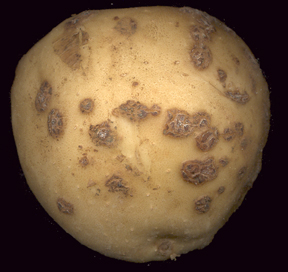
The client called in because his potatoes have spots that look like bugs have eaten chunks. The black inside the potato when cut goes deep, but the potatoes are not green. Potatoes had been grown in that area in the previous year.
DIAGNOSIS / RECOMMENDATION
Potato Scab. It was recommended that the soil pH be kept below 5.8, use certified seed potatoes, and rotate where potatoes are grown in the garden.
ADDITIONAL INFORMATION
Potato scab is a soil and seed-borne bacterial disease caused by Streptomyces scabies. It produces circular, corky, raised lesions or bumps on the tuber or root surface of potatoes. It can also be a problem of beets, carrots, parsnips, turnips, and radish (1). It does not affect eating quality once removed but there can be significant peeling loss with these lesions.
Common scab can be very difficult to manage and prevention of the disease relies on combining several different methods. These include: avoiding planting infected tubers, using a 3-4 year rotation away from potato; planting less susceptible potato varieties (none are immune); maintaining a high soil moisture content for 4-6 weeks after stolon tips begin to swell at the onset of tuber development; amending soil to lower pH and treating seed with appropriate fungicides when available. (2, 3, 4). It is important to avoid alkaline materials, especially lime and wood ashes, but also avoid mushroom compost and leaf compost. All of these will raise the soil pH. (5) In addition, avoid planting other scab-susceptible vegetables in that area for the same 3-4 years. (1, 5)
RESOURCE LINKS
(1) https://extension.umd.edu/hgic/topics/common-scab-vegetables (2)https://plantvillage.psu.edu/topics/potato/infos/diseases_and_pests_description_uses_propagation (3) http://vegetablemdonline.ppath.cornell.edu/factsheets/Potato_Scab.htm (4) https://www.pubs.ext.vt.edu/content/dam/pubs_ext_vt_edu/426/426-413/426-413_pdf.pdf (5) https://hgic.clemson.edu/factsheet/irish-sweet-potato-diseases/
All resource links live and accessed, July 3 2020)
By: Betsy Brown, Bedford Extension Master Gardener Volunteer; Help Desk Coordinator