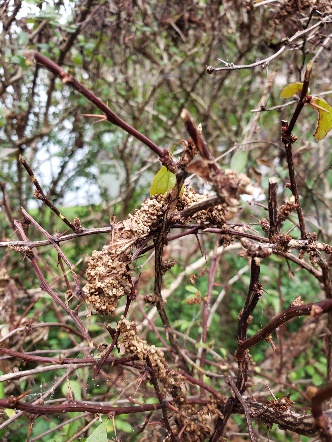
ISSUE: Client has barberry shrubs with webbing and defoliation, with bushes looking terrible.
DIAGNOSIS / RECOMMENDATION
The problem is the barberry webworm (Omphalocera dentosa). Defoliated branches and webs can be cut out and destroyed, but any preventative treatment must be applied earlier in the year when webs are just starting. Recommended controls are found in the Pest Management Guide.
ADDITIONAL INFORMATION
The barberry webworm is one of several problems of the non-native Japanese barberry bushes popular in home landscapes. The webworm is a small black caterpillar with white spots that ties together the leaves and shoot tips (4). The adult moth is Reddish to olive-brown moth with a wingspan of about 1 1/2 inches. It is found throughout the eastern US (5) and may also be found on mahonia plants. This pest is a member of the Lepidoptera, family Pyralidae; many other species in this family are pests of crops and ornamentals. As the larva feeds, it pulls the leaves together and feeds from the inside out, then forms brown clumps that actually are pupal cases constructed of leaves, frass and other material (2).
The Japanese barberry is a very common landscape planting, but it also is considered as an invasive species (3). Due to its easy maintenance, adaptability, and tolerance of dry, poor soils and urban conditions, it has become widely established. It is a popular choice due to its resistance to deer browsing. First introduced as an ornamental plant in 1875, it has escaped cultivation and forms thickets in woodlands and other habitats. Its dense foliage creates an ideal humid environment for ticks. Where possible, this shrub should be considered for removal due to its invasive nature.
RESOURCE LINKS
Ref 1 https://ask2.extension.org/kb/faq.php?id=726658
Ref 2 https://ask2.extension.org/kb/faq.php?id=358433
Ref 3 https://extension.umd.edu/resource/japanese-barberry
(All resource links live and accessed July 11, 2022)
By: Betsy Brown, Bedford Extension Master Gardener Volunteer; Help Desk Coordinator