• Home
  • Main Menu
    • About Us
    • Membership- Join Us!
    • History of Bedford Master Gardeners
    • Garden Grants
    • Plant Sale
    • Programs & Projects
    • Request A Speaker or Workshop
    • Evaluation Form for Programs and Workshops
  • Help Desk
  • Facebook
  • GROW and SHOW
  • Chestnut Project
    • American Chestnut Articles
  • Contact Us

Bedford Area Master Gardeners Association

Virginia Cooperative Extension

  • Home
  • Main Menu
    • About Us
    • Membership- Join Us!
    • History of Bedford Master Gardeners
    • Garden Grants
    • Plant Sale
    • Programs & Projects
    • Request A Speaker or Workshop
    • Evaluation Form for Programs and Workshops
  • Help Desk
  • Facebook
  • GROW and SHOW
  • Chestnut Project
    • American Chestnut Articles
  • Contact Us

Potato Plant Vines

July 1, 2019 by Carol O

The client called to ask why his potatoes (Irish) planted in mid-April already had vines dying in mid-July. He felt this was too soon.  He did not know the variety of potato.
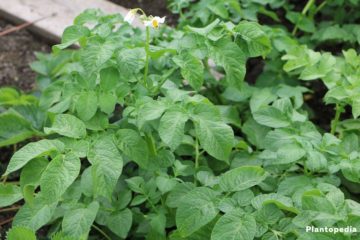
Source: http://www.plantopedia.com/solanum-tuberosum/

DIAGNOSIS / RECOMMENDATION

Because most potato varieties mature within about 90-120 days, the dying back of vines is likely normal senescence.  No actions were recommended.

ADDITIONAL INFORMATION

Potatoes planted in mid April typically will be ready for harvest beginning in early July, depending on the variety [1, 2, 3].  Potato vines will begin to die back about that time, although stress from environmental factors (either drought or too much water and high temperatures), insect damage, improper fertility, and diseases can hasten the dieback [4, 5].  In fact, tuber formation of potatoes ends when soil temperatures are consistently over 80°F, regardless of whether or not vine tops have died back.  [4].  Potatoes are heavy feeders in the garden, and having the proper fertility is important [2, 3, 6]  Knowing the variety and ensuring proper fertility will help in management of the crop.  Once the vines have died back, the tubers should be harvested and used or stored appropriately.

SOURCE June 2019  BAMGA’s From the Help Desk

BetsyB., Bedford Extension Master Gardener, Help Desk Coordinator

RESOURCE LINKS

All resource links live and accessed, June 12, 2019)

1) https://www.pubs.ext.vt.edu/content/dam/pubs_ext_vt_edu/426/426-331/426-331_pdf.pdf

2) https://hgic.clemson.edu/factsheet/potato/

3) https://extension.umd.edu/hgic/topics/potatoes

4) https://www.pubs.ext.vt.edu/AREC/AREC-66/AREC-66.html

5) https://vernonjames.ces.ncsu.edu/soil-science/soil-fertility/soil-fertility-management-information/potato-vine-premature-decline-causes-and-management/

6) https://www.pubs.ext.vt.edu/content/dam/pubs_ext_vt_edu/426/426-413/426-413_pdf.pdf

–A Bedford Area Master Gardeners Association (BAMGA) Publication–

Answers provided herein were based on specific situations and growing conditions.These recommendations may or may not be appropriate for all circumstances.For specific recommendations for your particular situation please contact your local Cooperative Extension Office.
Virginia Cooperative Extension programs and employment are open to all, regardless of age, color, disability, gender, gender, identity, gender expression, national origin, political affiliation, race, religion, sexual orientation, genetic information, veteran status, or any other basis protected by law. An equal opportunity/affirmative action employer. An equal opportunity affirmative action employer. If you are a person with a disability and desire assistance or accommodation, please notify Scott Baker at the Bedford Extension Office at 540-586-7675 (TDD number 800-828-1120) during business hours of 8:30 a.m. to 5 p.m.

Filed Under: Fruits /Veggies, Help Desk Tagged With: potato harvest, potato vines

← Tomato Diseases & Disorders Philadelphia: America’s Garden Capitol →

Copyright © 2026 · Lifestyle Pro Theme on Genesis Framework · WordPress · Log in