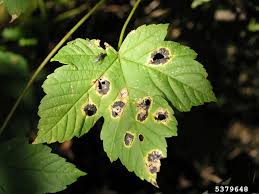
The client called in with a concern about a leaf spot on maple leaves. The Virginia Tech Plant Diagnostic Lab identified the leaf spot as purple-bordered (or purple eye) leaf spot (Phyllosticta minima). This is a very common disease of maples (including Japanese, red, silver, and sugar maples) but is not considered to be a serious threat. The recommendation was that the client rake and remove fallen leaves in the fall to reduce the amount of overwintering inoculum.
ADDITIONAL INFORMATION
Purple-bordered leaf spot is common throughout the Atlantic region [1, 2, 3]. It is characterized by spots up to ¼ inch in diameter with a pronounced purple border. The spots may be round or irregular in shape. Tiny, black fungal fruiting structures may dot the upper surface of the spots. [3]
All commonly grown trees and shrubs are subject to attack by one or more leaf-infecting fungi. The majority of trees and shrubs have learned to live with leaf spot diseases. Even severe defoliation will not cause the death of an otherwise healthy tree. Also, by the time symptoms of leaf spot are obvious, it is often too late to apply a chemical for control. Trees, which are subject to serious injury when attacked by a leaf spot fungus, are those trees that are under stress. This might include recently transplanted trees, trees growing under droughty conditions or trees weakened by continuous insect attack. [2, 3, 4]
Newly planted maples, and established maples that have been severely affected by leaf spot for several years, may benefit from treatments with a fungicide registered for that use. In order to be effective, the proper fungicide must be applied as a protectant before the fungus spore is disseminated to the leaf. Most leaf spot fungi infect trees early in the spring just as the leaves are unfolding. Three treatments may be needed for adequate control: one at bud break, one when leaves are half expanded, and one when leaves are fully expanded. [5, 6]
Since many of the leaf spot fungi over-winter on fallen leaves, one cultural method of reducing the severity of leaf spots is to rake and remove from your yard all old leaves under the tree. This will reduce the number of fungal spores available to infect developing leaves in the spring. Disposing of old leaves may not be effective if leaves from the same species of tree or shrub in the area are not disposed because spores of most of the causal fungi can be wind disseminated for long distances [2] [4]
SOURCE: September 2019 BAMGA’s From the Help Desk
BetsyB., Bedford Extension Master Gardener, Help Desk Coordinator
All resource links live and accessed, August 14, 2019
[1] https://hgic.clemson.edu/factsheet/maple-diseases-insect-pests/
[2] http://www.ladybug.uconn.edu/FactSheets/leaf-spot-disease-of-trees-and-shrubs.php
[3] https://extension.psu.edu/maple-diseases
[4] https://extension.umn.edu/plant-diseases/leaf-spot-diseases-trees-and-shrubs
[5] https://ask.extension.org/questions/400074

–A Bedford Area Master Gardeners Association (BAMGA) Publication–