Blue Ridge PRISM Recommendations:
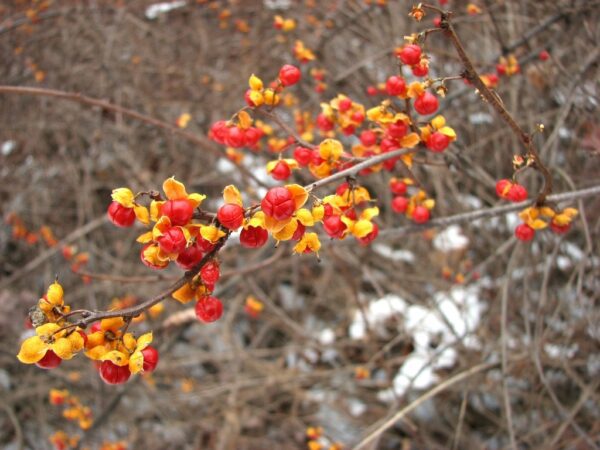
- Now is the time to identify and control this invasive vine since it is easy to spot during this time of year. Use our guide to identify Asiatic bittersweet (Celastrus orbiculatus) in the landscape.
- Identify and control small infestations before they get too large and hard to control.
Because it can spread so quickly and smother almost anything in its path, Asiatic bittersweet (Celastrus orbiculatus), aka round leaf bittersweet (formerly known as Oriental bittersweet), is rapidly taking over many American forests. As a result, the United States Department of Agriculture considers Asiatic bittersweet a national invasive species. Asiatic bittersweet is also listed as a noxious weed in the Commonwealth of Virginia.
Blue Ridge PRISM considers Asiatic bittersweet a five-alarm fire species, because of how fast it is spreading across the Virginia landscape and how quickly it can alter the ecosystem it overtakes.
Help preserve our tree canopy and forest health — Act Now (when it is easy to spot) to identify and control this invasive species on the land you steward.
For More information, view the Blue Ridge PRISM Asiatic Bittersweet Fact Sheet
Sources:
- Article – BlueRidgePRISM.org
- Photo – https://plants.ces.ncsu.edu/plants/celastrus-orbiculatus/